
.png)
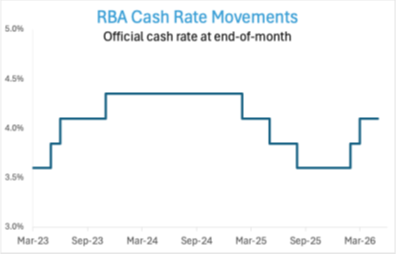
At its March meeting the Reserve Bank of Australia increased the cash rate by 25 basis points to 4.10%, seeking to curb renewed inflationary pressures driven in part by rising oil prices. This marks the second consecutive rate hike, following a period of easing that began only 12 months ago. For investors and businesses, these shifting rate cycles can feel like a roller coaster.
A SHORT-LIVED RELIEF
The relief felt by mortgage holders from declining interest rates proved short-lived. The rate cuts that began in February 2025 — taking the RBA cash rate from its cycle high of 4.35% down to 3.6% — came to an end in February 2026. The RBA is now signalling it will not underestimate inflation again, and markets are already pricing in a further rate rise at the next Board meeting on 7 May 2026.
In the post-meeting statement, the RBA noted that inflation is likely to remain above target for some time, with risks tilting further to the upside, including to inflation expectations. The Bank judged there to be a material risk that inflation would remain elevated for longer than previously anticipated.
THE BOND MARKET SAW IT COMING
This apparent directional reversal came as no surprise to markets. The bond market anticipated the next rate change would be an increase months ago, as yields rose sharply between October and December and are now at their highest level in more than two years.
Australian 10-year government bond yields began rising from early October, after CPI data from the Australian Bureau of Statistics revealed inflation to be more persistent and higher than economists had forecast. The Australian 10-year yield has now reached its highest level since 2011.
Notably, both Australian and US yields have also spiked since the escalation of conflict in the Middle East in early March — an event that has further fuelled global inflation concerns by driving up oil prices.

THE OIL PRICE SHOCK
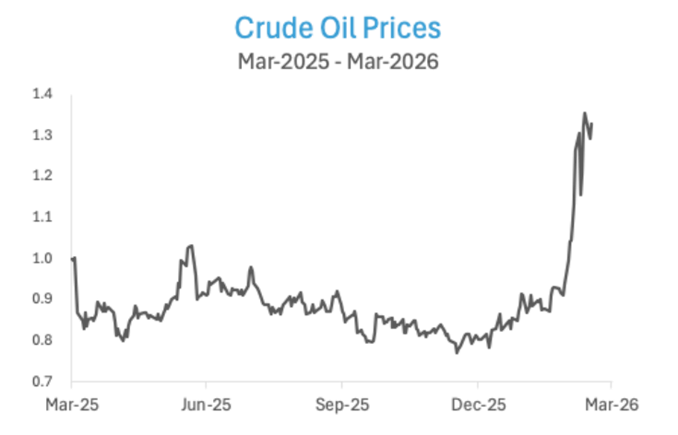
Global oil and gas prices have soared following US-Israeli strikes on Iran over the weekend of 28 March, disrupting energy exports from the Middle East and raising fears of supply shortages. The Dow Jones Commodity Crude Oil Index has risen by more than 40% since the start of the conflict, and with the Strait of Hormuz remaining closed, what many assumed would be a transitory spike may prove more prolonged.
This creates a particularly unwelcome complication for the Reserve Bank of Australia. While the Bank might typically look past a short-term supply shock, persistent underlying inflation makes that approach more difficult. Sustained energy prices risk pushing near-term inflation higher while simultaneously weighing on economic growth — a scenario that could force the RBA to continue raising rates even as the economy softens.
WHAT THE DATA IS SAYING
The March rate increase was widely anticipated once February's GDP data confirmed Australia's economy expanded at 2.6% year-on-year in Q4 2025 — above market expectations. Underlying inflation remains stuck at 3.8%, well above the RBA's 2–3% target band, giving the Board sufficient justification to act.
The bond market is also not following its typical playbook. In periods of geopolitical tension, investors usually seek the safety of bonds, causing yields to fall. Instead, markets remain focused on the inflationary threat, effectively dismissing recession risk. For bond yields to reverse course, there would need to be clear evidence that the conflict is materially affecting global economic growth.
WHAT THIS MEANS FOR YOU
While the rate movements of recent years may feel like a roller coaster, it is important to remember that the RBA is doing what it believes is necessary to return inflation to its 2–3% target. The central bank remains data dependent — as new economic information becomes available, the Board will assess its next move accordingly.
For our clients, this underscores the importance of maintaining a well-diversified portfolio structured to weather different rate environments. If you would like to discuss how the current rate outlook may affect your financial plan, please do not hesitate to contact your adviser.
Subscribe to our newsletter.
Learn about market trends, investment strategies, and financial planning.
Speak to one of our Advisers today.


